
Tuesday, 6 May 2014
Smaller jacket
From the leftover Perendale yarn I'd dyed for my Noro jacket I made this sweet one for the youngest grandchild.

Finished Noro jacket
 |
| Interesting design with back shorter than front |
 |
| Brilliant design with short rows |
 |
| Rows become vertical on the back |
Paua merino becomes waistcoat

 I spun 300g of Fibre 2 Go's paua merino sliver aiming to get wide bands of colour. I undid each of the 100g units to give six ends. I found the colour that was most common to the six ends and spun that in a worsted style. Then I found the next most common colour and spun that and so on. This also coped with the slight differences in the colours of the sliver. I'd bought 200g then another 100g months later.
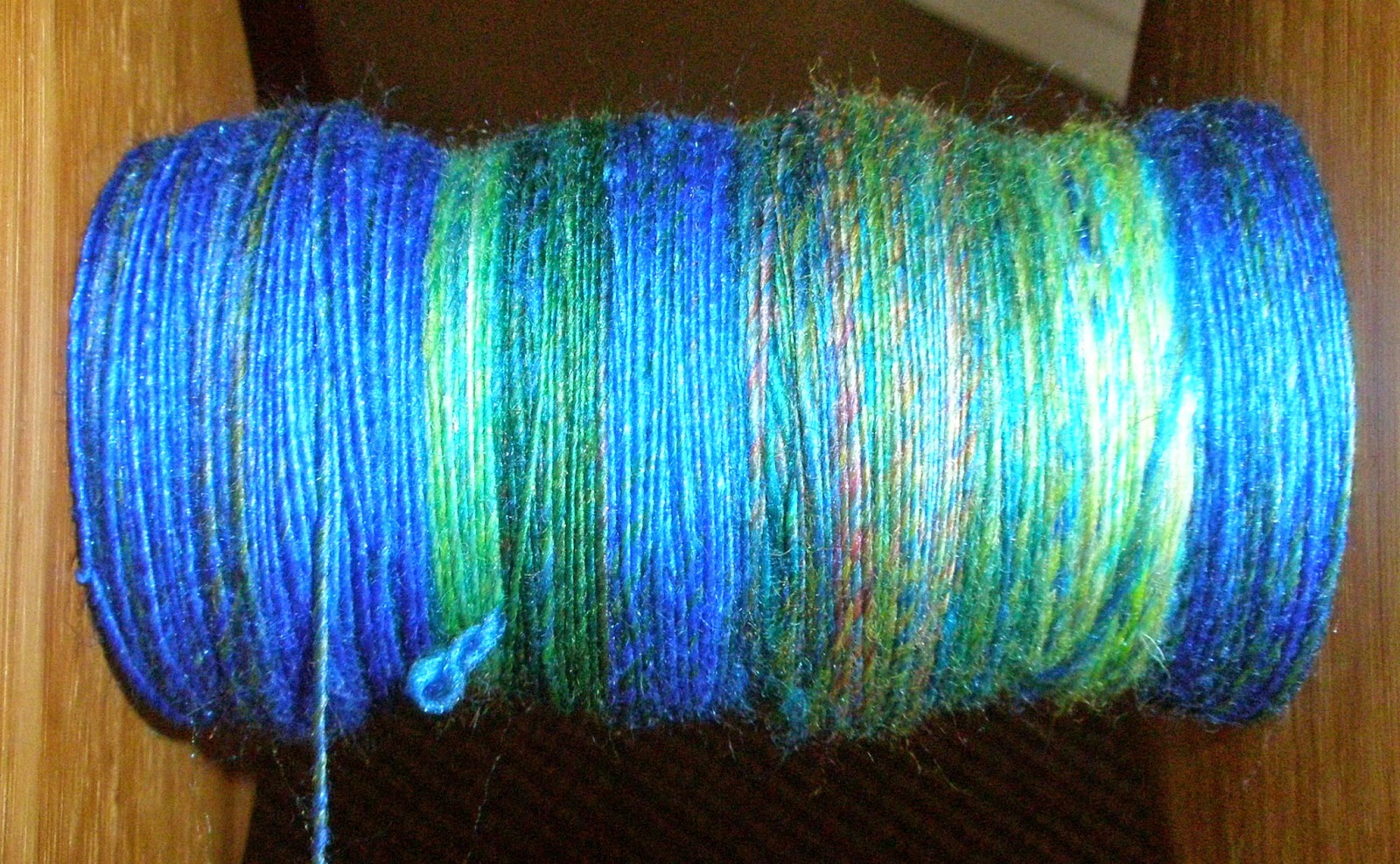 |
| Single ply |
Next I chain (Navaho) plyed the yarn. The yarn looked beautiful, smooth and rounded but I hadn't anticipated how heavy it would be and consequently what a short meterage I would get compared to 2 ply yarn.

The colours were very effective in the waistcoat but knitting it was like driving a car when you are running out of petrol. I had to unpick the fronts and lower the neckline to get enough yarn. Even then I was scrambling to finish it. The last lengths of yarn were cut from the ends left from casting on.
The buttons were a problem. My little town of Thames on the Coromandel Peninsula doesn't have much of a choice so I usually recycle old buttons. This time I had nothing suitable except for one button made from paua shell. Eventually I found a shop in Waihi that has a fantastic range. The owner imports buttons from England.
Sunday, 4 May 2014
Challenging 16+ colour yarn
I love the effects of the colour changes in Noro yarn and decided to try to dye and spin a yarn that also had long colour changes. One of my hands was severely out of action for months after I'd stupidly flick carded alpaca for a day. However I could still dye using my left hand. I hand painted metre after metre of merino and occasionally merino and silk and dyed using a microwave. It was exciting and also frustrating. I couldn't get a red red.
Then I separated out the colours in the skeins.

While I was on a weekend fibre retreat I carded the lot into batts. Then I admired them for the next 4 months. At the same time I was dreaming up idea after idea for using them.
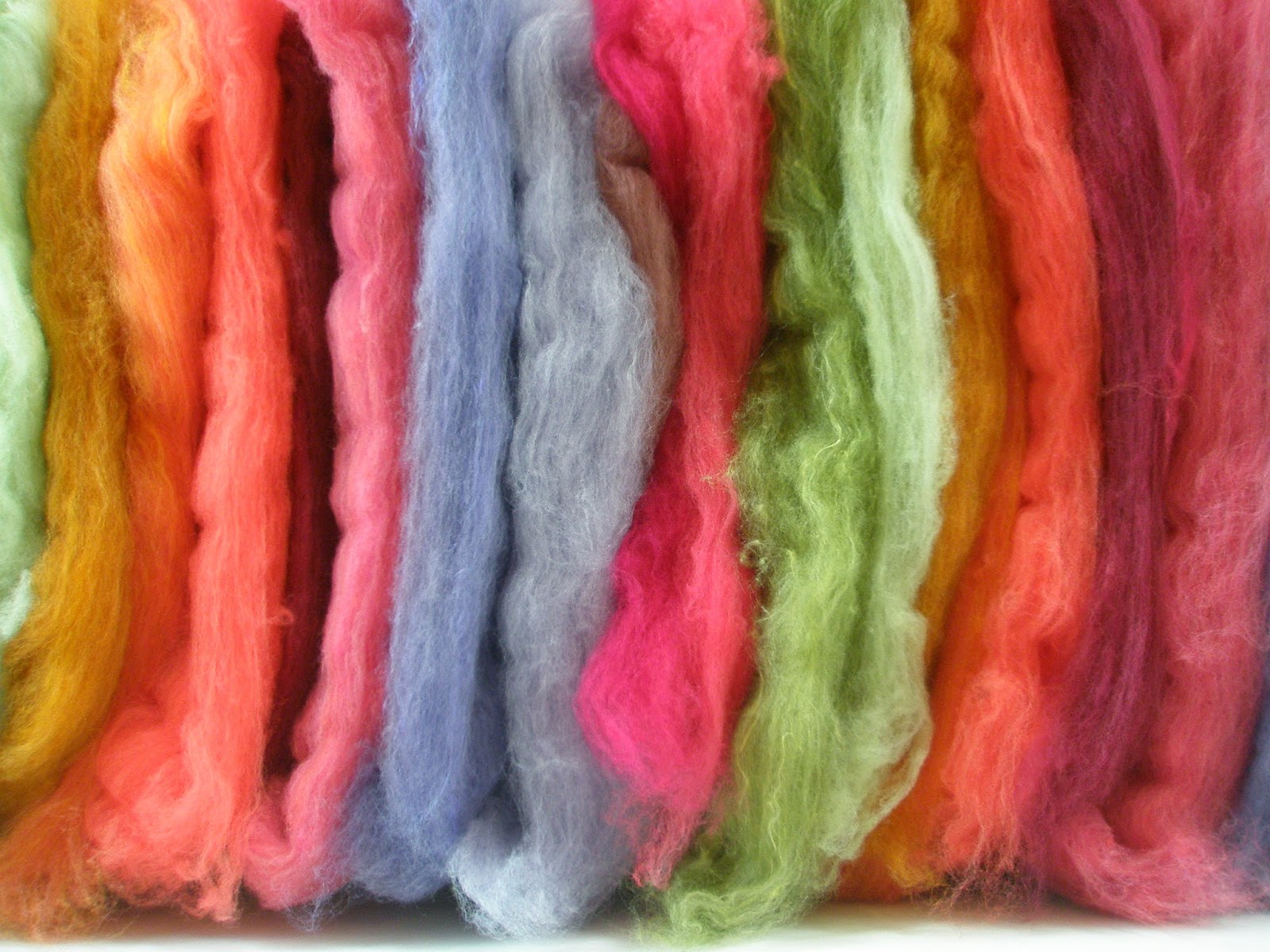
Spinning sequence: left from middle of picture
bright cherry
deep mushroom
pale mauve
deep mauve
rose
dark cherry
scarlet
orange
gold-brown
light green
mid green
red
The initial problem was how to spin the yarn. The obvious solution was to chain (Navaho) ply as the colours would easily form a sequence. However I wanted a light garment and chain plying gives a triple ply that is heavier than a two ply. The obvious answer was to spin the merino finer but fine yarns are not my forte. What about fulling a single? My experiment looked beautiful but I couldn't face fulling hundreds of metres of yarn. I could see tangles, snarls and disaster. After experiments with different techniques and whorl sizes I chose to spin the batts on my Majacraft Aura with the 7.3 whorl then ply.
The batts in total weighed about 450g. I decided to make 6 units. I had widely differing amounts of the various colours. There was 56g of pale green but only 17g of mushroom. I got out the scales and divided each colour into six. Five of them I put away in a box then I split my first unit of 16 colours into two for the 2 singles I would ply. But wait, there is more. I didn't want abrupt colour changes so I took a little of one colour and carded it with a little of the next colour to give a colour bridge from one to the next. But now it was getting very difficult to keep the weights the same for each ply. My scales don't really differentiate between 1, 2 and 3 grams. On Trademe I found scales that would measure in 0.01g so I ordered some.
I dizzed then plyed the singles and I'm happy with the colours. There were only 4 spots where I had to take out a metre or so because the colours weren't working. Here's the first skein done using my old scales.
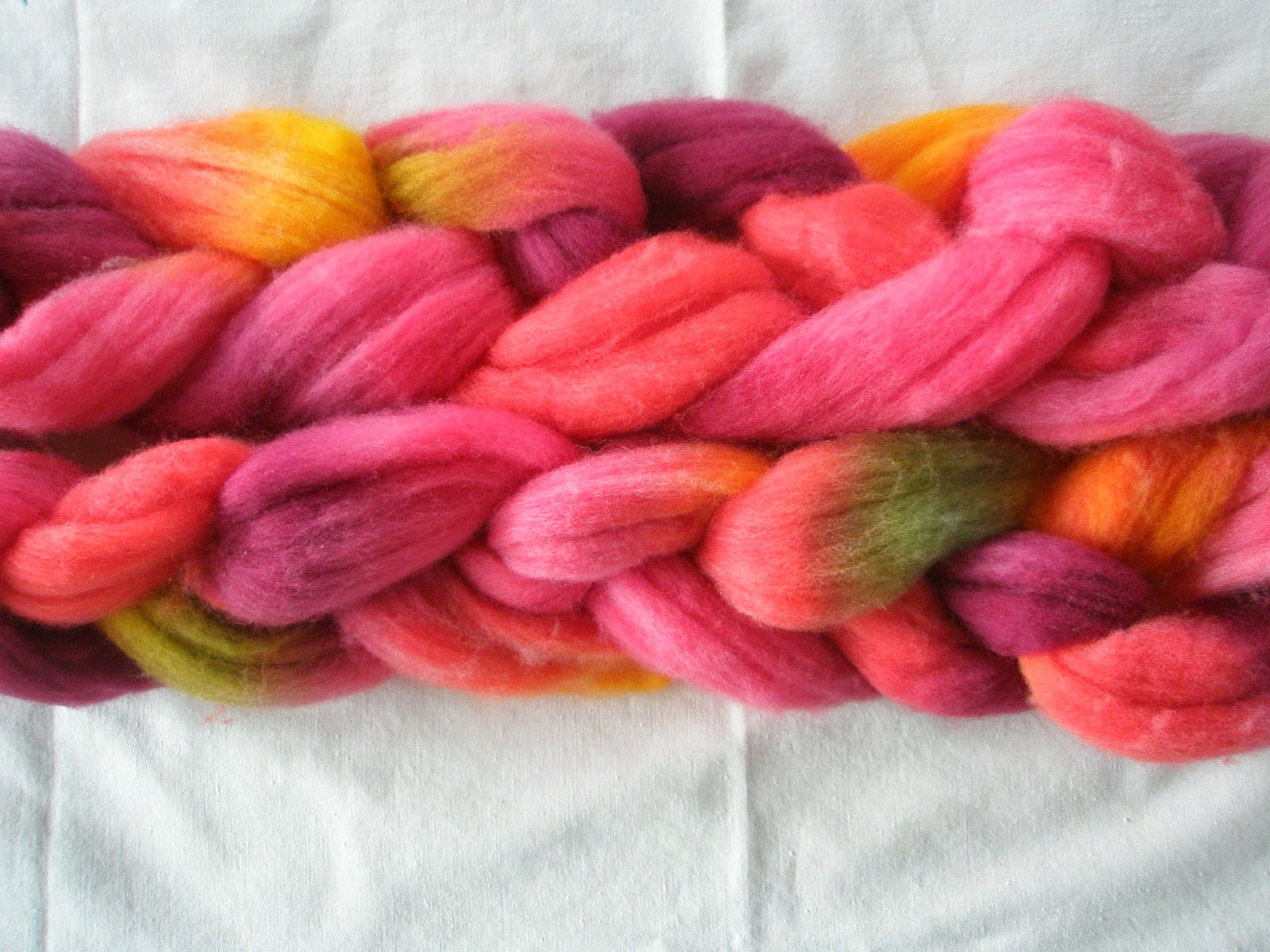 | |
| A handpainted length of merino |
While I was on a weekend fibre retreat I carded the lot into batts. Then I admired them for the next 4 months. At the same time I was dreaming up idea after idea for using them.
Spinning sequence: left from middle of picture
bright cherry
deep mushroom
pale mauve
deep mauve
rose
dark cherry
scarlet
orange
gold-brown
light green
mid green
red
The initial problem was how to spin the yarn. The obvious solution was to chain (Navaho) ply as the colours would easily form a sequence. However I wanted a light garment and chain plying gives a triple ply that is heavier than a two ply. The obvious answer was to spin the merino finer but fine yarns are not my forte. What about fulling a single? My experiment looked beautiful but I couldn't face fulling hundreds of metres of yarn. I could see tangles, snarls and disaster. After experiments with different techniques and whorl sizes I chose to spin the batts on my Majacraft Aura with the 7.3 whorl then ply.
The batts in total weighed about 450g. I decided to make 6 units. I had widely differing amounts of the various colours. There was 56g of pale green but only 17g of mushroom. I got out the scales and divided each colour into six. Five of them I put away in a box then I split my first unit of 16 colours into two for the 2 singles I would ply. But wait, there is more. I didn't want abrupt colour changes so I took a little of one colour and carded it with a little of the next colour to give a colour bridge from one to the next. But now it was getting very difficult to keep the weights the same for each ply. My scales don't really differentiate between 1, 2 and 3 grams. On Trademe I found scales that would measure in 0.01g so I ordered some.
I dizzed then plyed the singles and I'm happy with the colours. There were only 4 spots where I had to take out a metre or so because the colours weren't working. Here's the first skein done using my old scales.


Kid mohair corespun

I teased out some lustrous kid mohair curls and corespun then around a commercial mohair yarn. The skein was delightlully soft.
The resulting yarn was unbalanced so I
 spiral plyed it with a fine silk/mohair thread. It is just visible at the bottom right.
Now I'm wondering what to make with it. It feels so good around my neck that I could just wear it as a necklace/cowl.


Friday, 28 March 2014
Majacraft Camp 2014
I recently had a great dose of fibre fun at Majacraft's camp at Rotorua. For a video of camp highlights visit http://www.majacraft.co.nz/blog/?=850/blog/?=850.
 Speed Dating with Fibre Tools was my first workshop taken by Esther Rodgers aka Jazzturtle. Jazzturtle Creations I learnt from Esther Rodgers how to use a blending board and after making my first few rolags I was hooked. Luckily I had also chosen a workshop in which participants made a blending board. Even better Owen chose to demonstrate how to attach the carding cloth using my board so I had mine made for me. On the last morning I sat in the sun happily making little rolags and more little rolags.


Aren't they beautiful!
Fibres on the blending board.
I spun mostly a woollen yarn using a long draw on my Majacraft Aura. I wasn't sure that this would work on the Aura because of its pigtail orifice but it did. Well I thought it had worked until I tried plying. I got myself into plying strife because I had accidently spun one bobbin on a different whorl setup to the other. The yarn broke in places because it poorly spun. All the different fibres, merino, corriedale,silk sliver, silk noil and mohair curls that looked so exciting in the rolags were beastly to spin longdraw.

 The skein of yarn - Next time I will take the fibre off the blending board using a diz working back and forth across the board. That way more of the fibres will be in line. The difficulty with the rolags is that they had some inherent twist. Woollen spinning works best with evenly carded rolags. I had hoped I'd get away it - I didn't.
The mess on the bobbin as I searched for a broken end.
Jewel Yarn
I succumbed to this 19 micron merino yarn called Precious Jewels from Lyn Walsh of Fibres 2 Go last July then I bought another 100g at our Thames Creative Fibres Open Day last October.


The amazing colour changes after I had carefully opened out the sliver.
The two 100g wheels of fibre varied slightly in colour so I needed to put each on its own bobbin then ply the two. Starting with one wheel I gently opened out the sliver. I divided the length of sliver in half then split each half into 7 strips rolling each one into a ball. I dizzed all the strips and rerolled. Now I had 14 balls in one container. Next I repeated this process for the second wheel but split from the other end.I spun a worsted yarn from the first set onto the bobbin. The second set went onto the next bobbin. When I plyed the bobbins there was my jewel yarn with flashes of colour.


Subscribe to:
Posts (Atom)